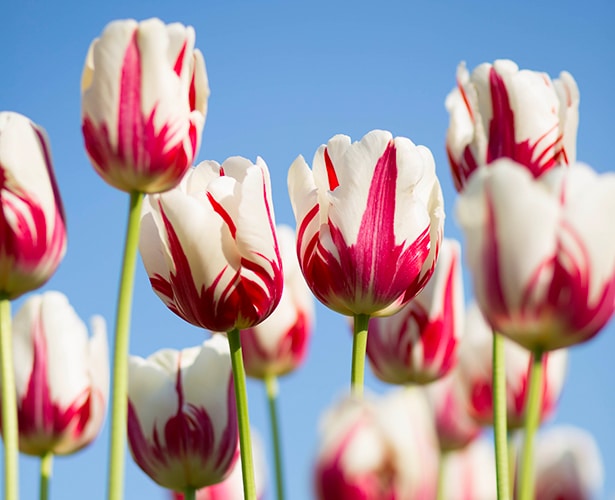
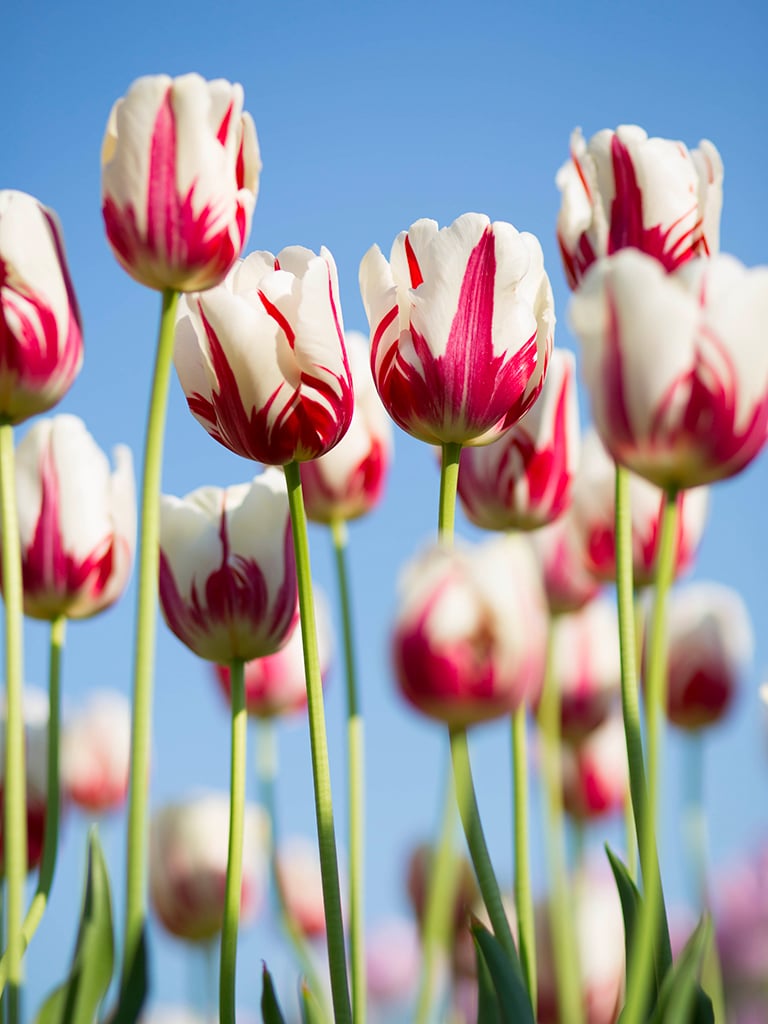
Photo: Unsplash/Kwang Mathurosemontri
Tulips come from mountainous regions of Turkey and Central Asia, where winters are cold and summers are cool and dry. There, they are hardy, durable perennials. However, when they grow in humid climates, in richer soils, or when the summer is very hot, many hybrid tulips, having bloomed fully for a few years, become smaller or do not bloom at all. In such conditions, sometimes even the bulbs disappear. It should be remembered that the deeper the bulbs are planted and the better the soil is drained, the stronger the tulips will be. It is necessary to carefully choose the varieties to plant. A more beautiful effect will be achieved by combining several in the same spot.
Bulb Arrangement
We plant groups of large-flowered perennials with lush foliage, such as peonies, alliums, or daylilies, which will help to camouflage the tulip leaves as they fade. If you cannot resist the desire to treat yourself to colorful tulip beds but do not like the yellowed leaves that follow, we treat them as annuals: remove the bulbs from the ground after flowering. We will be sure to have beautiful colorful flowers every spring and, as a bonus, we will be able to try new varieties or arrange the colors differently from year to year.
Choose the Bulbs Wisely
Large bulbs are preferable, as small ones produce small flowers. Soft, waterlogged bulbs or those showing signs of mold should be avoided. Tulip bulbs have a skin that resembles that of an onion; a loose or torn “skin” can accelerate root development once the bulb is planted. If the bulbs cannot be planted immediately after purchase, they should be stored in a paper bag, in a cool, dark place.
Three Phases of Planting
1. We place the bulbs in the ground, pointed side up. The size of the bulb determines the depth—generally, a hole equal to three times the height of the bulb is excavated. Large bulbs are spaced 7 to 15 cm apart, while small ones are spaced 3 to 6 cm apart.
2. If the bulbs are to bloom year after year, bulb fertilizer is added according to the manufacturer’s instructions.
3. We generously cover the bulbs with soil and water. When the soil begins to cool (in October or November, depending on where you live), it is covered with a mulch 5 to 8 cm thick (compost, manure, wood chips, or shredded leaves…) to retain moisture and protect the area where the bulbs are planted during the winter.

Photo: Unsplash/Rupert Britton
Some Blooming Tips
—Tulips need cold to bloom. The colder the climate, the earlier the bulbs should be planted, ideally six weeks before the ground freezes.
— Tulips grow best in full sun. A little shade is not harmful, as long as the flowers receive at least six hours of sunlight per day. Good soil drainage is necessary: if it is too wet, the bulbs may rot during the winter.
— To prepare the soil where the bulbs will be planted, it is necessary to work the soil with a garden fork. We remove weeds. We dig a trench or a large hole; we can also make separate holes for each bulb or plant the bulbs in clusters.
“With tulips, less is not more.” Most people are too frugal when planting tulip bulbs. For a beautiful effect, generous bouquets are preferable to a few flowers here and there. In the garden, try to form at least three groups of six to twelve bulbs arranged in a triangle, with the top point of the triangle facing forward. Let’s avoid lining up bulbs like little soldiers!
“We need to protect them.” Bulbs are very vulnerable when newly planted, while the soil around them is still loose. If squirrels are likely to eat them, we need to plant them deeper, firm the soil, and place leaves on the ground to hide the holes we have dug. If it is believed that this will not be enough to deter intruders, a grid can be placed on the ground and held in place with a large wire.
“And when will the flowers fade?” They are removed, allowing the plant to concentrate its energy on strengthening the bulb instead of producing seeds. The foliage is left in place to allow the bulb to rebuild its strength for the next spring. In fact, the leaves have an essential task: they use sunlight energy to produce nutrients that will be stored in the bulb for future blooming.
— The foliage turns yellow and dries. This takes about six weeks, then cut it. If we want to get rid of the leaves first, we choose early tulips.
— The next spring, when we see the tulips coming up from the ground, we sprinkle the young plants with bulb fertilizer.
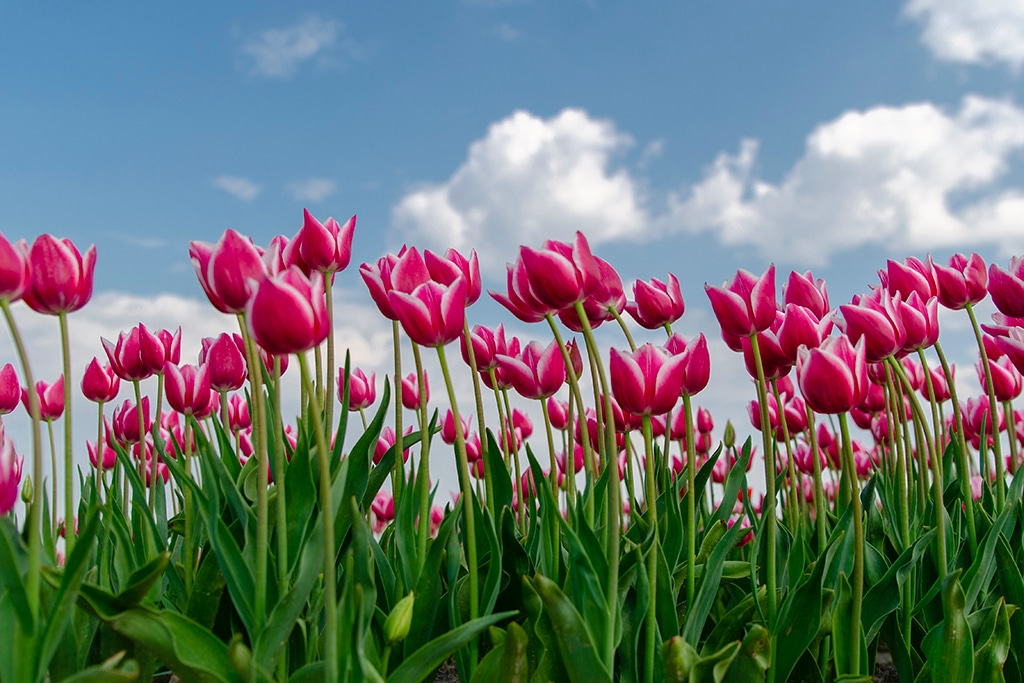
Photo: Unsplash/Ad Muller
Blooming Periods
— Early: The Purissima, also known as Emperor White, is a beautiful pure white tulip belonging to the Fosteriana family. Mme Lefeber, from the same family, is also known as Emperor Red. The heart’s joy of the Kaufmanniana family, Little Red Riding Hood, and Donna Bella from the Greigii family bloom very early in the season: April to early May, in the Montreal area.
— Hybrids: Some varieties of tulips exist in their natural state. They have been used for centuries to create today’s tulips, known as hybrid tulips. For early or mid-season blooming, we try varieties such as Late, which develops a white and golden flower in the shape of a star, Turkestanica, Tulipa batalinii Bright Gem, or Tulipa praestans Fusilier.
— Mid-season: The Bastogne, blood red, Don Quichotte, pink-purple, and Early Glory, fuchsia violet, are part of the Triumph family. They are shorter than those of the Darwin family, which includes the bright red Apeldoorn tulip, Glorie Holland, and Pink Impression. These tulips bloom in mid-May in Montreal.
— Late: The late single tulips (late May to early June) are known for their opulent flowers, wide variety of colors, and very long stems. They are beautiful in bouquets. Among the most popular varieties are the Queen of the Night, with a velvety brown-purple almost black, as well as the all-white Maureen, the soft pink Menton, and the Angelique, with a beautiful fragrant pale pink.
Read also: August: what to do in the garden
This text is a report published on August 29, 2005.
Tag: when to plant tulips