
When searching for a house with a garden less than twenty minutes from the sea for the price of a two-room apartment in the Paris suburbs, Brittany consistently appears in the results. The ratio between housing costs and proximity to the coast remains the most concrete argument for those considering moving to Brittany.
But beyond the postcard image, the Breton real estate market is undergoing a transitional phase that changes the game for buyers and investors alike.
Energy renovation in Brittany: the hidden true cost of older properties
In Brittany, prices per square meter remain significantly lower than those in Île-de-France. One factor weighs heavily on the actual budget of a purchase: the energy status of the older Breton housing stock.
As of January 1, 2025, properties rated G in the energy performance diagnosis can no longer be rented out. Properties rated F will follow in 2028, and those rated E in 2034. For a rental investment in Rennes, Saint-Brieuc, or Quimper, this means that the listed price of an older property does not reflect its actual operating cost.
In coastal municipalities, where buildings often date back several decades, insulation work is a cost that buyers regularly underestimate. As detailed by the Destination Bretagne website, opportunities exist, but renovation must be integrated from the search phase to avoid unpleasant surprises.
Specifically, before signing a preliminary agreement, three things should be checked:
- The DPE class of the property and the date of the diagnosis, as a DPE conducted before the 2021 reform may give an overly favorable image of the property
- The technical feasibility of insulation (granite walls, slate roofs, proximity to the coast complicating certain materials) and the associated quotes
- Available local aids, as the Brittany Region and certain intercommunalities offer complementary schemes to MaPrimeRénov’
New real estate market in Brittany: a slowdown to watch
The logical reflex when older properties present energy performance issues is to turn to new ones. However, the Breton new housing market is showing signs of slowdown.
In the second quarter of 2026, new housing sales in Brittany declined year-on-year. At the same time, listings and available stock increased. Over the four quarters leading up to June 2026, sales also decreased.
For a buyer, this context presents a paradox: more choices on paper, but increased caution from developers that may slow the launch of new programs, particularly in medium-sized cities like Vannes or Lorient. Buyers considering a real estate purchase in Brittany must account for this gap between theoretical supply and the reality of deliveries.
Zero net artificialization: what it changes for settling in Brittany
The national goal of zero net artificialization by 2050 is not just an abstract concept in Brittany. Breton communities must reduce their consumption of natural, agricultural, and forest areas at an intermediate pace before this deadline.
In practice, buildable land on the outskirts of towns will become scarcer. Construction projects are increasingly focused on densifying existing centers and rehabilitating brownfields. For those dreaming of a one-thousand-square-meter plot in a new subdivision ten kilometers from Rennes, feedback varies on this point, but the trend is clearly towards tightening land supply.
This constraint has a positive effect for town centers: it promotes the renovation of existing buildings and the revitalization of local businesses. Municipalities in Morbihan or Côtes-d’Armor that were losing residents to the outskirts see this policy as an opportunity to regain attractiveness.
Rental investment and urban densification
For a rental investment project, this dynamic points towards central locations. A renovated apartment in the center of Quimper or Saint-Brieuc, well-rated on the DPE, presents a better rental yield potential than a detached house on the outskirts whose land value may stagnate.

Cost of living in Brittany: the factors that really make a difference
Housing grabs attention, but the cost of daily life in Brittany deserves a line-by-line examination. There is a marked gap with major metropolitan areas on two main budget lines.
The transportation cost is lower than in Île-de-France, provided one has a vehicle. Commute times are shorter, parking remains accessible in most Breton cities, and the TER network covers the main routes. The TGV connects Rennes to Paris in less than an hour and a half, making hybrid remote work viable for Parisian professionals.
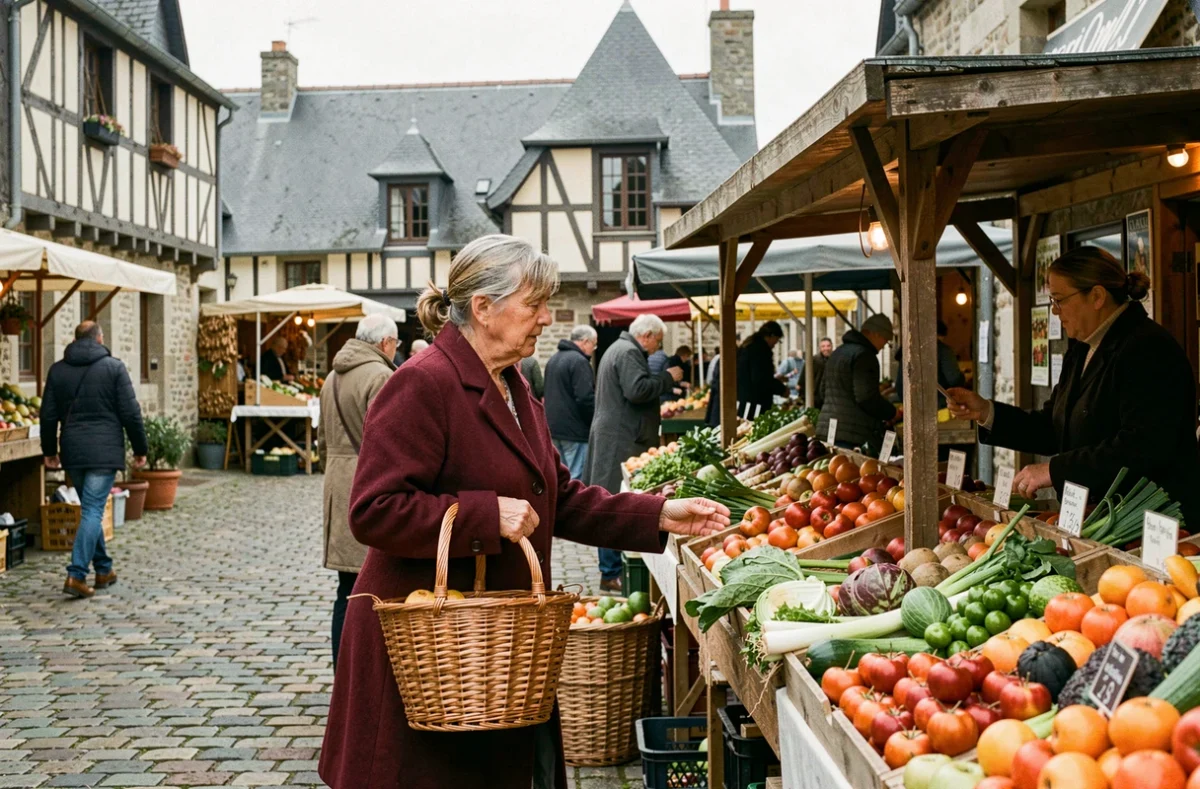
Local food also drives prices down for those who frequent markets and short supply chains. Brittany remains a major agricultural and maritime production region, and this proximity to producers is reflected in the grocery basket.
- Seafood purchased at the fish market or direct sales at the port, at prices significantly lower than those in Paris supermarkets
- Abundant local farming, with well-established basket and AMAP networks in all Breton urban areas
- Cider, butter, crepes: iconic products remain accessible in their production territory
Job prospects and daily life: beyond remote work
Remote work has accelerated relocations to Brittany, but relying solely on remote work remains risky. Corporate policies are evolving, and a partial return to the office can turn a Breton project into a logistical deadlock if the employer is based in Lyon or Marseille.
Rennes concentrates most of the regional economic dynamism, with digital, agri-food, and cybersecurity sectors that are hiring. Coastal cities like Brest or Lorient rely on the maritime economy and defense. For a sustainable relocation project, checking the compatibility between one’s industry and the local job market remains the most concrete precaution.
The Breton real estate market is going through a pivotal period between energy regulation, land sobriety, and a slowdown in new developments. These constraints are reshaping the right choices: prioritize town centers, anticipate renovation costs, and ensure professional activity is compatible with the territory.