Transforming a terrace into a flowering garden involves solving a rarely posed equation: what weight can the soil support, which plants actually survive in pots under intense heat, and what co-ownership rules govern the installation of planters and trellises? These three parameters determine the feasibility of the project long before choosing colors or furniture.
Load-bearing capacity, drainage, and substrate: the technical data of a green terrace
The first limiting factor of a garden on a terrace is not sunlight, but the allowable load of the slab. A pot filled with moist potting soil weighs significantly more than when dry. The weight at water saturation, not the weight when dry, determines the feasibility of any plant installation at height.
On a rooftop terrace, a waterproofing diagnosis and a structural study are recommended before any project. The thickness of the substrate directly affects the load, watering needs, and maintenance level. The thinner the substrate, the faster it dries out, and the more frequent the watering must be.
For those who wish to flower their terrace with Conseil au Jardin, this load-bearing constraint guides the choice towards lightweight containers (resin, fiber) rather than massive terracotta pots. Drainage remains a priority: a base of clay balls or pumice and sufficient drainage holes prevent root asphyxiation.
| Criterion | Terracotta pot | Resin / fiber pot | Treated wood box |
|---|---|---|---|
| Empty weight (relative) | High | Low | Medium |
| Weight at water saturation | Very high | Moderate | High |
| Root insulation (heat) | Good | Poor | Good |
| Durability | Fragile to frost | Frost resistant | Variable depending on treatment |
| Natural drainage | Porous (lateral evaporation) | None (only from the bottom) | Correct if pierced |
Terracotta offers better thermal regulation for roots, but its weight restricts it to terraces with confirmed load-bearing capacity. In contrast, resin is suitable for balconies and lightweight roofs, provided its lack of insulation is compensated by a sufficiently large pot.
Heat-resistant potted plants: what really thrives on a full-sun terrace
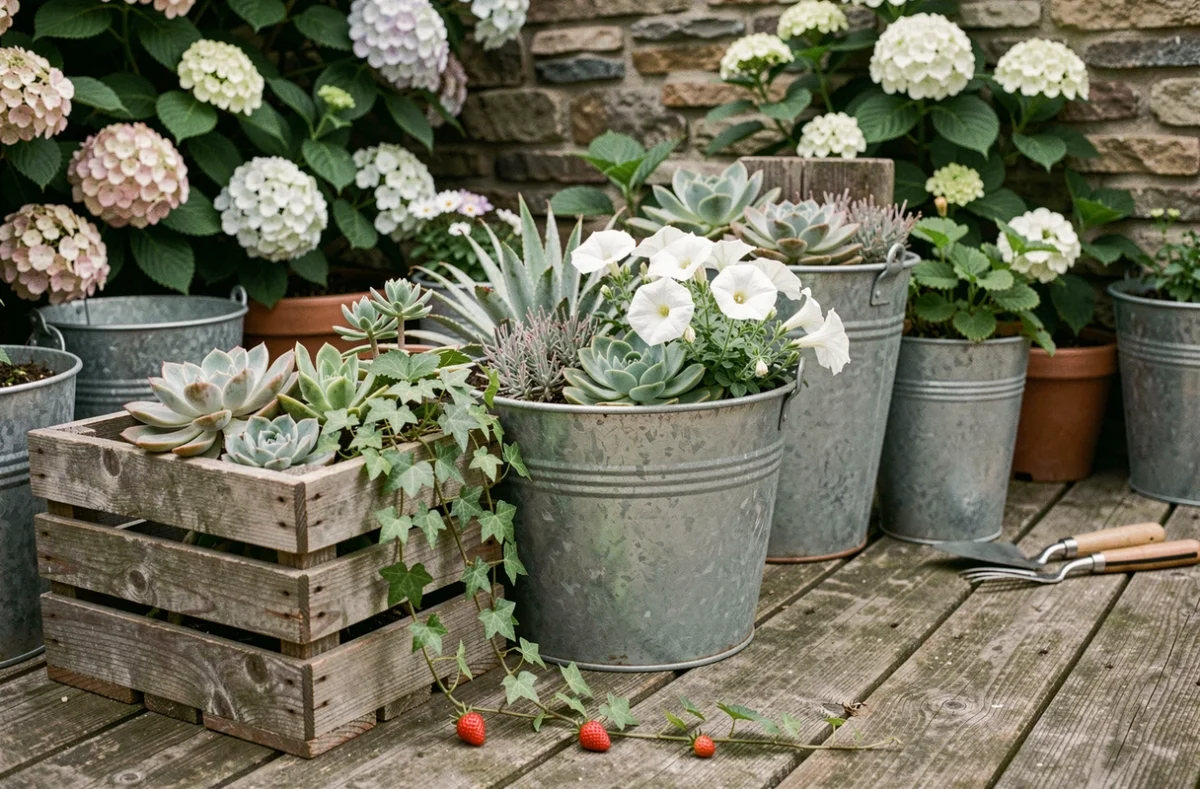
The recent horticultural trend favors water-efficient species for exposed terraces. Lavender, rosemary, grasses, star jasmine, and helianthemum are among the common recommendations. Their common point: a tolerance to heat and dry periods that is above average.
Drought-resistant does not mean without watering. In pots, the root volume remains limited, and the water reserve depletes much faster than in the ground. Even a plant known for being low-maintenance must be closely monitored during its establishment period, which generally lasts the first full season.
Three levers allow for reducing watering frequency without sacrificing flowering:
- Mineral mulching (gravel, crushed slate) limits surface evaporation and keeps roots cool, unlike organic mulching which can ferment in an overheated pot.
- Sufficiently large containers provide a substrate volume where moisture is retained longer between waterings.
- Infrequent but generous watering encourages roots to grow deeper into the pot, enhancing the plant’s autonomy.
Star jasmine and helianthemum require impeccable drainage to avoid root rot. These plants tolerate drought, but not excess stagnant water. The choice of substrate (mix of potting soil, coarse sand, pumice) is as important as the choice of species.
The pitfalls of climbing plants on terraces
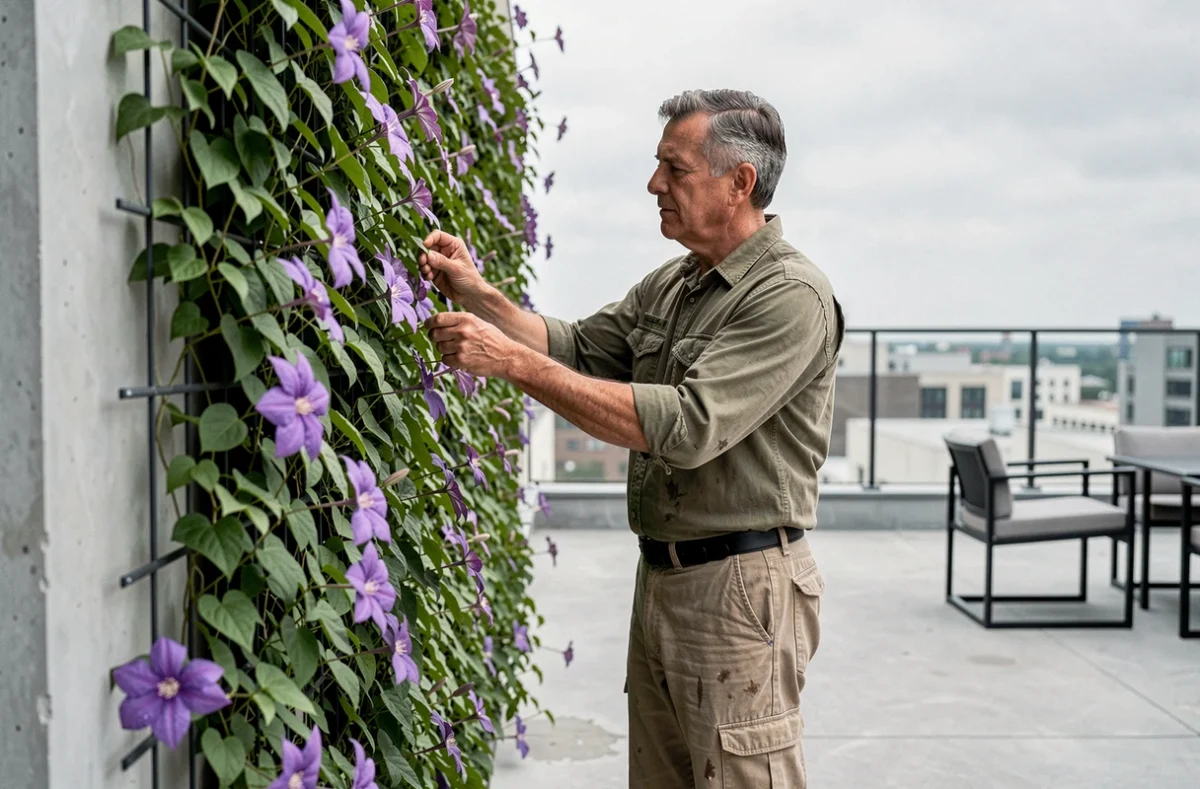
Climbers like star jasmine transform a bare wall into a green wall. Their installation on a co-owned terrace poses a concrete problem: the co-ownership regulations may prohibit fixtures on the facade. Self-supporting trellises, placed in a weighted box, circumvent this constraint without drilling into the wall.
The weight of an adult climbing plant with its support and its box of moist substrate reaches significant values. It is better to anticipate this total weight from the design stage rather than discovering a load-bearing issue two years later.
Co-ownership rules and flowering terrace: what the regulations cover
In co-ownership, the arrangement of a terrace or balcony is not entirely free. The regulations may govern the visible exterior appearance from the street, the allowable loads on the structure, attachments to railings, and water drainage towards common areas or lower floors.
Planters are recommended to be placed inside the balustrades, not outside. This often-unknown rule aims to prevent objects from falling and to protect the facade. Trellis fixings should not damage the walls, which remain common areas even if the balcony is private.
Water drainage is a frequent point of friction between neighbors. Poorly controlled watering that runs off onto the balcony below can lead to conflicts, even requests for restoration. Suitable saucers or a water recovery system under the pots reduce this risk.
Exposure and microclimates on a terrace: adapting plantings to the reality of the sun
A south-facing terrace does not receive the same light as a west-facing balcony. The reflection from the ground (light tiles, concrete) amplifies the heat felt by the plants and can scorch foliage that would survive in the ground.
A light-colored wall behind the pots can significantly increase the temperature at the foliage level due to the reflective effect. Placing the most sensitive species out of this reflection, for example behind a box of grasses that filters the light, alters the microclimate at the pot level.
The shade cast by a pergola, even a light one, changes the situation for the plants installed underneath. A green pergola with a deciduous climber provides shade in summer and allows light to pass through in winter, extending the flowering season of the species planted at its base.
The choice of plants for a flowering terrace is therefore made pot by pot, observing the actual sunlight at different times. A terrace of a few square meters can present two or three distinct microclimates between the corner sheltered by a wall and the exposed area at the edge.