
Trixhentzi does not set up in Parisian galleries or international digital art fairs. This Breton collective has chosen to establish its immersive devices in media libraries, community centers, and rehabilitated wastelands, in rural and peri-urban areas. This positioning questions how contemporary digital art can exist outside cultural metropolises.
Trixhentzi and the digital third-place model in rural Brittany
Digital art is most often structured around connected galleries, specialized fairs, or large distribution platforms. Trixhentzi operates according to a different logic, relying on partnerships with local Breton authorities to set up its residencies and installations in municipalities that lack contemporary art museums or dedicated exhibition spaces.
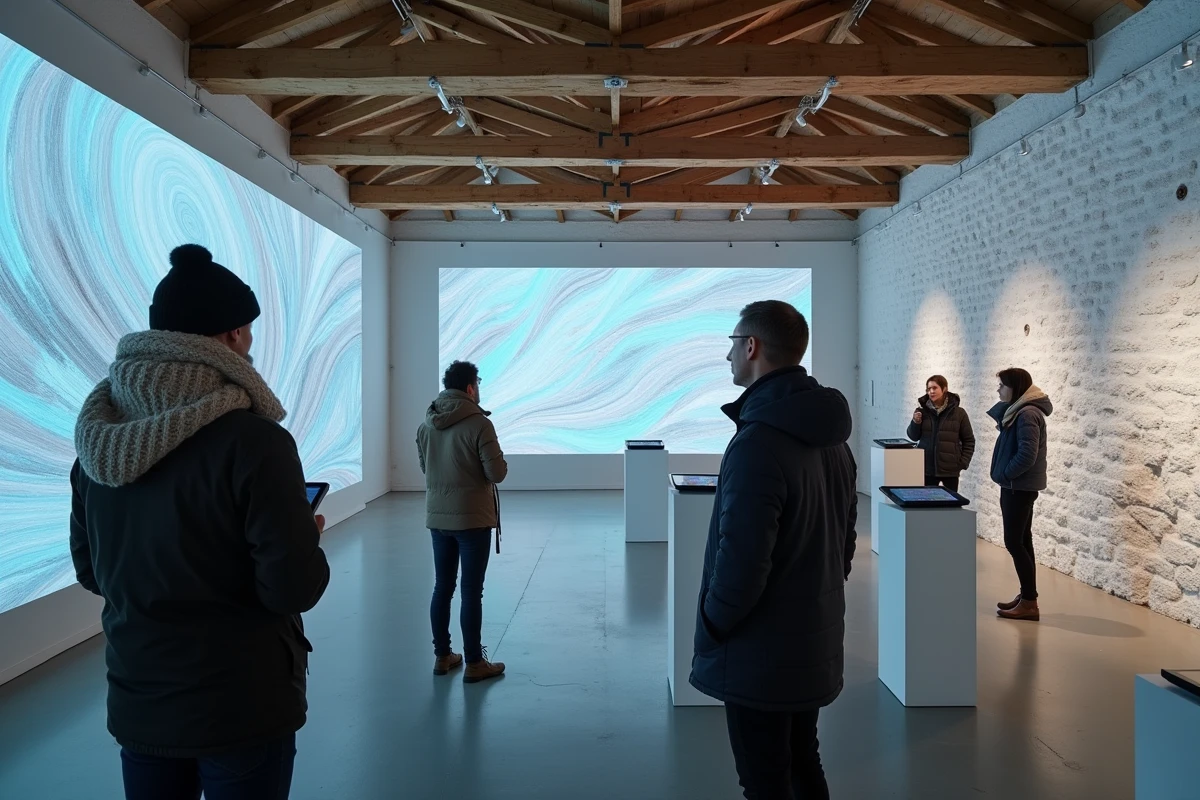
The principle is based on residencies described as “outside museum circuits.” An artist or an artist-developer duo settles for several weeks in a third place, a wasteland, or a municipal facility. The work produced on-site is then presented to the residents, who become the first spectators and sometimes the testers of the interactive devices.
This approach allows for the documentation of Trixhentzi’s influence on BreizhPower – The 100% Breton magazine through concrete field feedback, rooted in identifiable places and audiences that do not usually frequent digital art spaces.
Residency, prototyping, and territorial dissemination: the Trixhentzi production chain
The originality of the collective lies not only in its geographical choice. It resides in a complete chain that combines artistic residency, technical prototyping, and public testing in situ. While most structures separate these three stages (creating in the studio, producing in the studio, distributing in the gallery), Trixhentzi concentrates them in the same place and at the same time.
On-site, the teams mix various profiles: visual artists, developers, sound engineers, set designers. Prototyping is done under real conditions, with the constraints of the location (acoustics of a multipurpose room, lighting of a media library, network speed of a rural municipality).
This approach produces results different from what is observed in traditional residencies:
- The works are designed to function in spaces not dedicated to art, which imposes specific technical choices (portability of installations, energy autonomy, simplicity of interaction for a non-initiated audience)
- Feedback from residents during the testing phase sometimes modifies the device before its final version, creating a form of co-construction rarely documented in the field of digital art
- Dissemination remains local or regional, raising questions about the visibility and sustainability of the produced works
Contemporary digital art outside the metropolis: what Trixhentzi reveals about the limits of the model
The choice to territorialize digital art in rural Brittany is not without tensions. Some local elected officials see it as a lever for cultural attractiveness for municipalities seeking dynamism, while others question the ability of these projects to reach an audience beyond the occasional event.
The question of funding remains open. Trixhentzi’s residencies rely on partnerships with local authorities and associative structures. This model works as long as the subsidies continue, but no public data currently allows for measuring the economic autonomy of the collective in the long term.
There is also a paradox inherent in this approach. Digital art, by definition reproducible and disseminable at a distance, is here intentionally anchored in a physical territory. The immersive installation designed for the media library of a municipality with a few thousand inhabitants will not have the same audience as a work exhibited in a metropolitan art center or disseminated online.

Digital visibility, a blind spot
The available data do not allow for conclusions about Trixhentzi’s online dissemination strategy. The collective has a presence on social media, but the documentation of the works produced in residency remains fragmented. For a movement that claims digital as a medium, the absence of a structured online archive raises questions.
On the other hand, this digital discretion could also be a deliberate choice: prioritizing the physical experience, the direct relationship with the local audience, rather than video capture or online reproduction. The two logics coexist with difficulty.
Brittany and digital art: an ecosystem under construction
Trixhentzi does not work in isolation. Brittany has a network of cultural structures and regional institutional actors that form a favorable environment for the emergence of projects intersecting art and technology.
The collective is part of a broader dynamic where Breton third places become spaces for cultural experimentation, not solely dedicated to coworking or entrepreneurial digital initiatives. This transformation of third places towards artistic functions deserves attention, even if it remains poorly documented at this stage.
Trixhentzi questions the ability of contemporary digital art to exist outside the usual legitimization circuits (museums, fairs, online sales platforms) and to produce cultural value in territories that are generally excluded from it. The coming years will reveal whether this model of territorialization can be sustained or if it will remain an isolated experiment.