The term 808 comes up in almost every conversation about modern music production. Behind this number lies a precise drum machine, the Roland TR-808, whose deep and sustained kick has redefined the role of bass in hip-hop, trap, and beyond. Measuring the influence of this machine requires tracing its technical journey, its sound mutations, and how the industry continues to utilize it.
Roland TR-808 vs. its digital emulations: what has changed
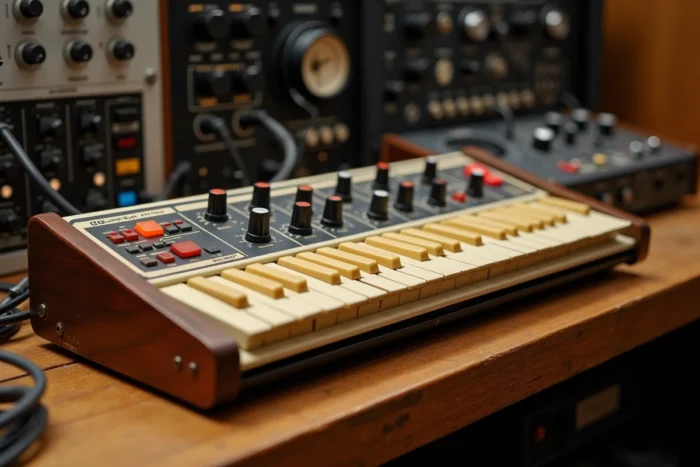
The original drum machine used an analog synthesis circuit to generate its kick, snare, clap, cowbell, and tom sounds. Each hit was produced in real-time by oscillators and filters, without relying on recorded samples. This architecture explains the unique character of the 808 kick: a deep, long, pitch-controllable sine wave.
Roland has since reintegrated the TR-808 into its digital ecosystem. The machine is available as a plug-in via Roland Cloud, and the TR-8S drum machine offers manufacturer-approved emulations. To learn more on Web United, the shift from analog circuitry to software modeling changes how young producers discover this foundational sound.
| Criterion | Original TR-808 (analog) | Roland Cloud / TR-8S Emulations |
|---|---|---|
| Sound Generation | Real-time analog synthesis | Digital circuit modeling |
| Kick Tuning | Physical potentiometer (Tone/Decay) | Software parameters replicating the same behavior |
| Access | Second-hand market, very high price | Subscription or purchase of the plug-in |
| Sound Palette | Kick, snare, toms, clap, cowbell, hi-hats, etc. | Identical, with added processing layers |
| Dominant Use Today | Collection, high-end studio | Common production, home studio beatmaking |
This table shows that access to the 808 has become democratized without changing the fundamental sound. The difference lies in the workflow: a producer in 2024 loads a preset, whereas their predecessor turned a potentiometer.
808 Kick in Trap and Drill: Two Opposing Treatments
The kick from the TR-808 is used differently across genres. In trap, which emerged in Atlanta, the 808 bass is tuned to follow the melody. Producers stretch the decay duration, saturate the signal, and create fully melodic bass lines. The kick becomes a tonal instrument, not just a rhythmic marker.
In contrast, in UK drill or Brooklyn drill, the treatment favors shorter 808s, often combined with slides (quick pitch glides between two notes). Since the early 2020s, the trend of sliding 808s has spread to Jersey club, phonk, and baile-funk, creating bass lines reminiscent of synthesizer portamento.
- Classic Trap: long, saturated 808, tuned to the key of the track, often in a very low register
- UK/Brooklyn Drill: drier 808, frequent slides, fast tempo
- Phonk and Jersey Club: sliding 808 with pronounced distortion, sometimes layered with an acoustic kick
- Afrobeats and Amapiano: more subtle use of the 808, often filtered to make room for percussion
These variations illustrate that the 808 is no longer a single sound but a family of treatments derived from the same original circuit.
The Constraint of Mobile on 808 Mixing
Listening on smartphones and consumer headphones has changed mixing practices. Major labels increasingly request “808-friendly mixes” in their briefs to beatmakers. The goal: to avoid distortion on the small speakers of TikTok, Instagram Reels, and YouTube Shorts, where a growing share of listens is concentrated.
In practical terms, this pushes to shorten 808 sub-bass and compress them more. A kick that sounds massive in a club can become inaudible or distorted on a phone. Producers add harmonics in the upper spectrum so that the brain reconstructs the deep fundamental, even on a speaker incapable of reproducing it.
Cultural Significance of the 808 Beyond Music
The number 808 has transcended sound production to become a cultural marker. Kanye West titled his album 808s & Heartbreak in direct reference to the machine, associating the sound with an emotional and minimalist aesthetic. In French rap, the 808 bass structures almost all trap and drill productions since the mid-2010s.
The term also serves as a shorthand among producers. Saying “send me an 808” in a studio refers to an audio file of a pitch-controllable deep kick, whether it comes from a real TR-808, a Roland plug-in, or a third-party sample pack. The word 808 now refers to a type of sound, not a machine.
Musical Expression and Creation of New Movements
The massive dissemination of this sound has contributed to the emergence of entire sub-genres. Without the pitch-controllable 808 kick, the melodic trap of Future or Young Thug would not have the same harmonic foundation. The first drill groups in Chicago built their sound identity around repetitive and aggressive 808 patterns before the movement spread to London and then Paris.
This impact goes beyond the simple question of an instrument. The TR-808, originally designed as a backing tool for musicians, has ultimately defined the deep voice of several decades of popular music. The fact that Roland has chosen to maintain its official emulations confirms that the demand remains strong, both among beginner beatmakers and experienced composers.
The next evolution will play out in the listening format. As short-form platforms dictate technical constraints, the 808 will continue to mutate, more compressed, shorter, enriched with harmonics, while retaining that deep signature that makes it recognizable in a split second.