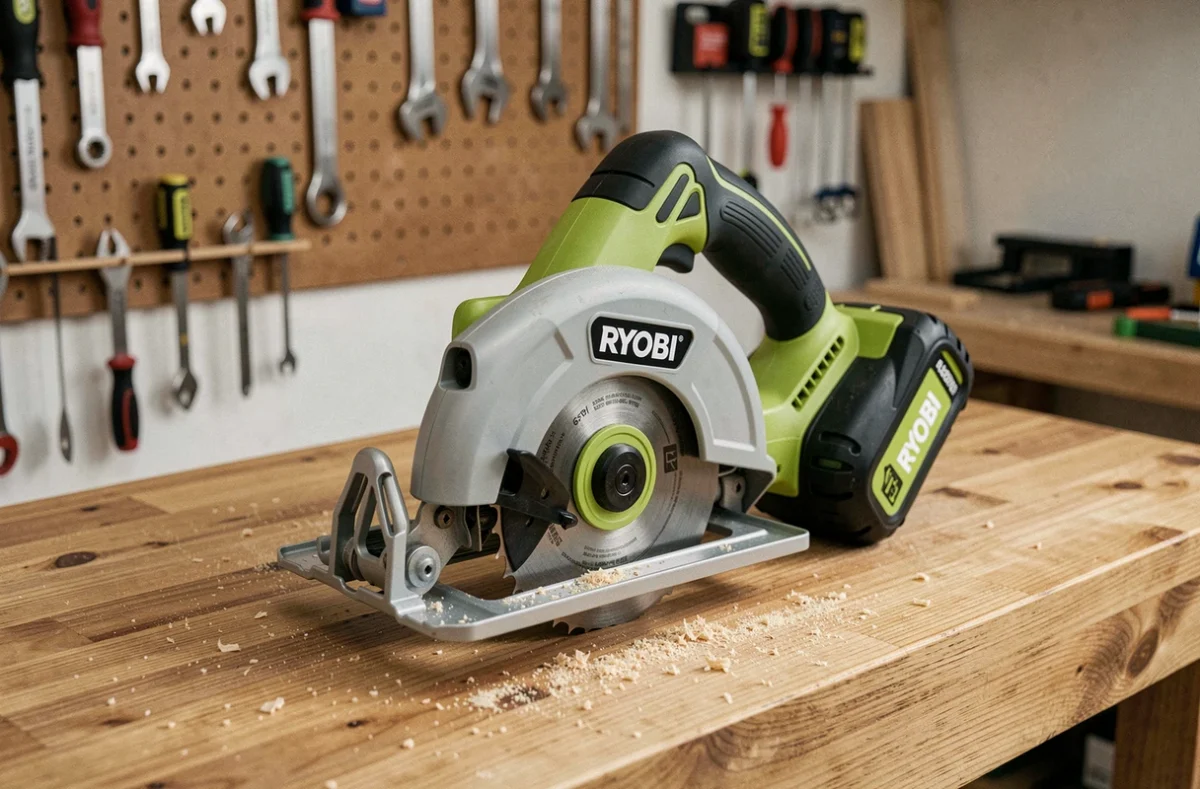
The Ryobi R18CS-0 is built around a 165 mm, 24-tooth blade powered by an 18 V motor. Its stated cutting depth is 52 mm at 90° and 36 mm at 45°, and it weighs 2.4 kg without a battery.
These specifications place it in the compact circular saw segment, suited to solid wood, plywood and standard sheet materials, but not to deep cuts in thick glulam or repetitive cutting on site.
165 mm blade and 45° cutting depth limitations
The 165 mm diameter is the most common compromise for 18 V saws. It allows clean cuts through typical interior construction materials: battens, formwork boards and particleboard panels. The 52 mm depth at 90° covers the vast majority of interior renovation work.
The main limitation is bevel cutting. At 45°, capacity drops to 36 mm. A full bevel cut through a 40 mm softwood door jamb is impossible without turning the workpiece or switching to a larger-diameter tool. We recommend checking bevel-cut thicknesses carefully before committing to a joinery project.
The supplied 24-tooth blade is suitable for fast cuts in softwood and unfinished plywood. On melamine or laminate, chips at the blade exit remain visible. Replacing the blade with a model with 40 teeth or more significantly improves the finish on these composite materials, without any noticeable loss of cutting speed.
ONE+ 18 V compatibility and battery choice for the R18CS-0
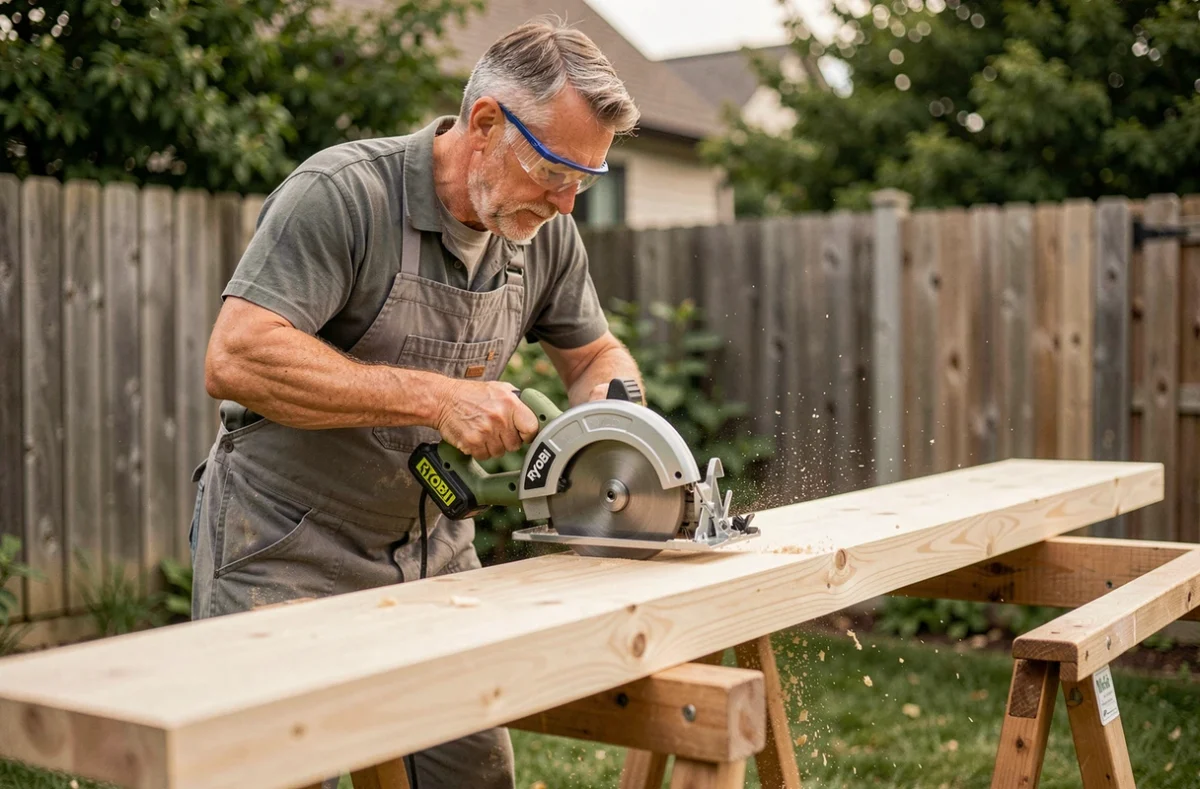
Sold as a bare tool (without a battery or charger), the Ryobi R18CS-0 circular saw uses the ONE+ platform, which shares the same battery format across more than a hundred tools. For users who already own Ryobi 18 V tools, the initial cost is limited to the tool itself.
Battery choice directly affects runtime and balance in the hand. A 2.0 Ah battery keeps the total weight below 3 kg, making vertical cuts and overhead work easier. A 4.0 Ah or 5.0 Ah battery extends runtime but shifts the centre of gravity towards the rear of the tool.
- 2.0 Ah battery: suitable for occasional cuts, maximum lightness, runtime limited to a few dozen cuts in 20 mm softwood
- 4.0 Ah battery: a good compromise for half a day of intermittent work, with a reasonable total weight
- 5.0 Ah battery: best for extended sessions or cutting dense wood, with a noticeable increase in weight
The total cost (tool + battery + charger) is about twice the price of the bare tool. This is worth considering for anyone buying into the ONE+ ecosystem for the first time.
Shoe and adjustments: what product listings don’t tell you
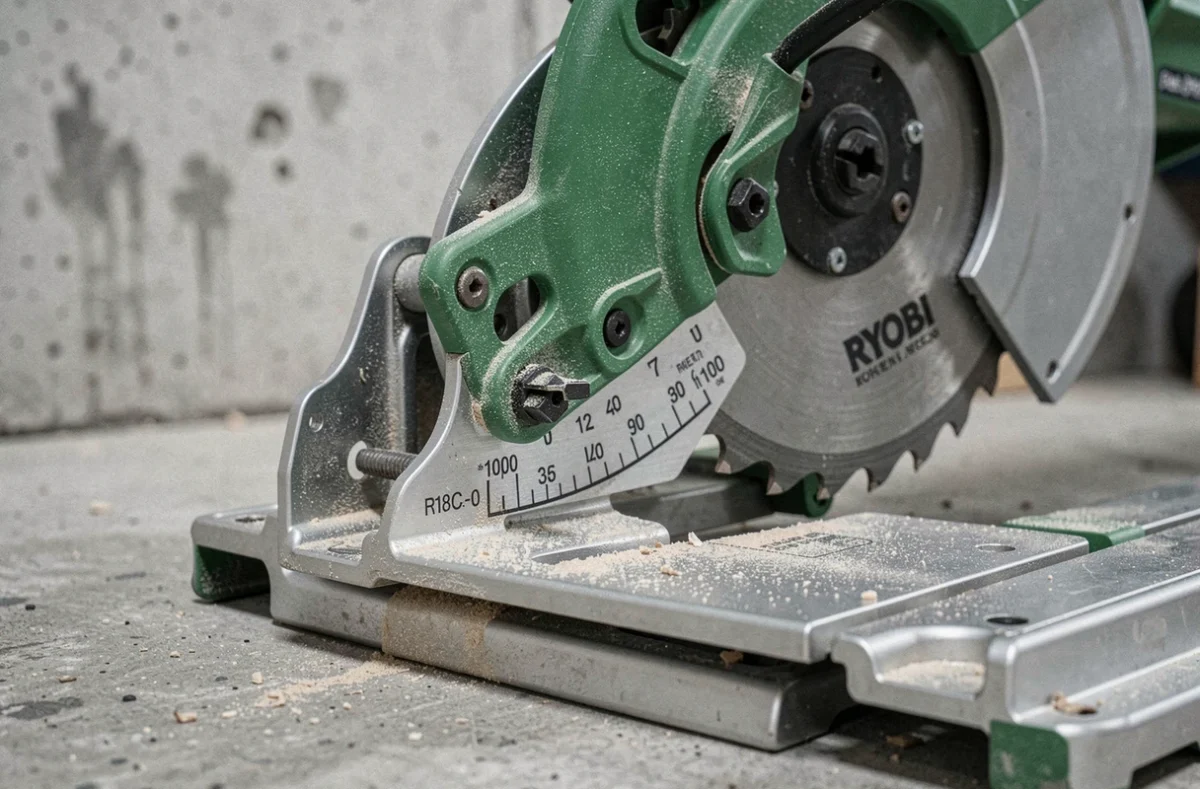
The aluminium shoe offers adequate rigidity for this segment. Cutting depth is adjusted using a side lever, while the bevel angle is set with a screw mechanism covering the 0–45° range. Adjustment accuracy depends on how firmly everything is tightened: a lever that isn’t locked securely can let the shoe move during a cut, especially on bevel cuts where lateral forces are greater.
The lack of laser guidance sets this saw apart from some competitors in the same price range. With no laser or LED light, following the cut line relies entirely on the shoe’s guide mark and the use of a rip fence or aftermarket guide rail. On long cuts (panels over one metre), a deviation of a few millimetres is likely without an external guide.
The adjustable dust outlet allows you to connect a vacuum. In practice, this keeps the cut line visible, partly making up for the lack of a laser. Without dust extraction, sawdust quickly builds up in front of the shoe’s guide mark, so you’ll need to blow it away regularly.
Rip fence and straight-cut accessories
The supplied rip fence attaches to the shoe and is suitable for straight cuts at a constant distance from the edge of a panel. For cuts through the middle of a panel, an external guide rail remains the most reliable option. Ryobi does not offer a dedicated rail for this model in its ONE+ range, but universal rails on the market with a standard-width shoe fit without difficulty.
Safety and dust management on the R18CS-0
The retractable lower guard covers the blade when the saw is idle and retracts automatically as the blade enters the workpiece. The spindle lock makes blade changes easy, using the supplied Allen key.
- Two-step safety switch: prevents accidental start-up when inserting the battery
- Retractable lower guard: regularly check that the return spring works and that sawdust isn’t obstructing the mechanism
- Adjustable dust outlet: position the port on the side opposite the operator to avoid blowing dust towards your face
The R18CS-0 has no active anti-kickback system. When cutting knotty or damp wood, kickback is a risk, as with any circular saw without a clutch mechanism. Firmly clamp the workpiece and maintain a steady feed rate for the best protection.
Ryobi R18CS-0 compared with competing 18 V circular saws
Within the Ryobi range, the R18CS115 (115 mm) is designed for light-duty cuts. The RCS18X1-0, with its brushless motor and 184 mm blade, offers greater capacity at a higher price. The R18CS-0 sits in the middle of Ryobi’s 18 V range, offering the best balance of compact size and cutting depth.
Compared with direct competitors (Bosch GKS 18V-57, Makita DHS660Z, Einhell TE-CS 18/165), the R18CS-0 stands out with one of the lowest entry prices in its segment. The trade-offs are the lack of a laser, a brushless motor and a finer-cutting blade as standard.
For DIYers who already own ONE+ batteries, it is clearly the more economical choice. For a first-time purchase that includes a battery and charger, the price gap with competitors narrows considerably.
The R18CS-0 does its job on light-duty sites and renovation projects where portability matters more than raw power. Its well-documented limitations can be addressed by choosing the right blade and always using an external guide for precision cuts.